


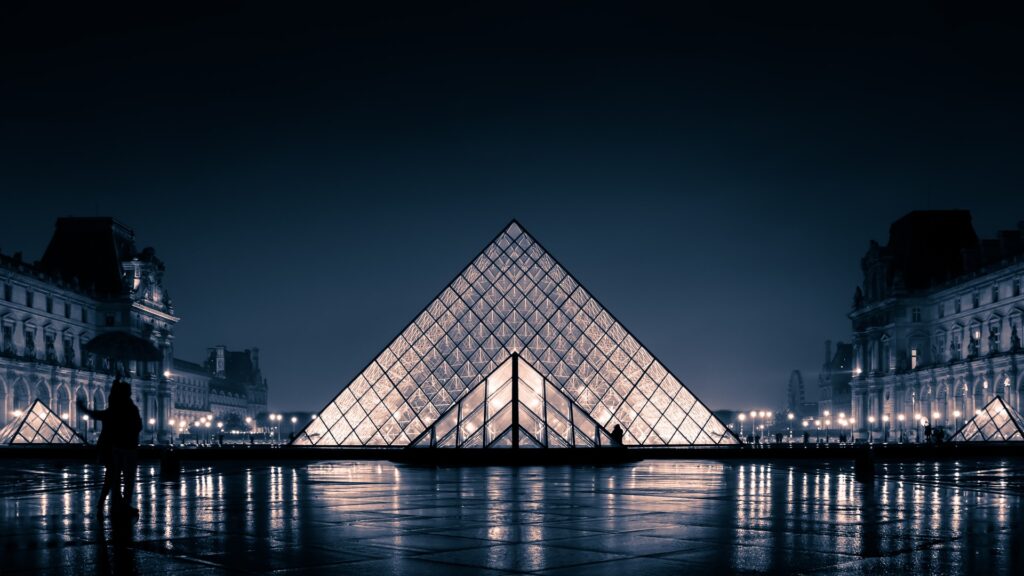
A must for anyone visiting Paris, the Louvre is the largest museum in the world by exhibition area and has a collection of almost 40,000 objects and works, covering every possible form of art and spanning several millennia of history. Few museums in the world are as prestigious and rich in masterpieces as the Louvre Museum. Today we will take you to discover the best works of art to see in the Louvre.
The Gioconda
Who doesn’t know Leonardo da Vinci’s Mona Lisa? There is no need to even mention it, because it is one of the most famous works of art in the world. Also known as the Mona Lisa, the painting is displayed on the first floor of the Denon Wing, where it is always surrounded by a crowd of admirers. Made in the years 1503-1506, it still remains a mysterious and fascinating work today. The identity of the woman is uncertain: according to tradition she would be Lisa Gherardini, wife of Francesco del Giocondo, from whom the work derives.
Even today, the Mona Lisa fascinates with her natural pose and lively character, rendered thanks to her famous shadows, a painting technique developed by Leonardo da Vinci. Through light layers of oil paint, enamel, Leonardo managed to create an elusive figure, but at the same time to embody its presence.


The Virgin of the Rocks
In addition to the Mona Lisa, the Louvre houses another famous masterpiece by Leonardo da Vinci, the Virgin on the Rock, oil painting on wood transferred to canvas from 1483 to 1486. Displayed on the first floor of the Denon wing, it is one of the finest religious paintings of the Renaissance genius. The work celebrates the mystery of the Incarnation through the figures of Mary, Jesus Christ and St. John the Baptist.
The title refers to the scene behind the sacred group, in which we see a fantastic landscape with caves and protruding rocks that form a vast penumbra around the figure, disappearing into a distant brightness. Curiosity: there is also a second version of Our Lady of the Rock, kept at the National Gallery in London, containing some iconographic variations.


Venus de Milo
Absolutely not to be missed is the Venus de Milo, a Parisian marble sculpture without arms and with an original base that depicts Aphrodite, goddess of love and represents the ideal of female beauty of ancient Greece. Located on the ground floor of the Sully wing, the sculpture is the finest Greek artwork on display in the Louvre.
Discovered by chance by a farmer on the island of Milo in 1820, it was probably made by Alexander of Antioch around 100 BC, in the Hellenistic period, even if its simple style reunites it with classical Greek sculptures. It is not known exactly which episode in the life of the goddess the sculpture refers to: according to some researchers it would be the image of Venus as the winner who offers Paris a golden apple.

Nike of Samothrace
In addition to the Venus de Milo in the Louvre, you can admire the famous Nike of Samothrace, a Hellenistic sculpture carved in white marble from Paros and gray marble from the island of Rhodes, dating from 200-190 BC. The sculpture, now devoid of the head and shoulders, was found fragmentary in 1863 by the French archaeologist Charles Champoiseau on the island of Samothrace, from which it took its name.
The statue depicts the goddess of Victory (Nike in Greek) in the guise of a winged woman resting on the prow of a warship. The sculpture on the ground floor of the Denon Wings had a great impact on the art world.


Love and Psyche
The Louvre houses one of the most beautiful and famous statues in the entire history of art, the sculptural group Cupid and Psyche. The work, created in the years 1787-1793 by the sculptor Antonio Canova, presents a myth taken from Apuleius’s Metamorphoses, in which Love revives a loved one, reviving it with a kiss.
Antonio Canova is considered the greatest representative of neoclassicism, a European cultural movement that arose between the second half of the eighteenth century and the first decade of the nineteenth century that brought fashion back to the classical model of Greco-Roman art.
Thanks to this work, the sculptor achieved perfection thanks to the precise balance of forms as well as the harmony of gestures and proportions. There is also another lesser-known version of Cupid and Psyche in the Louvre, also by Canova, where the couple is represented standing.
